Showing posts with label Movies. Show all posts

Tuesday, February 06, 2018

"Phantom Thread" (2017)

Imagine a fairy tale where Cinderella plays the villain, where the story begins as a romance but then slowly twists into a horror movie. Lush costuming and soft colours hide a sinister aggression that slowly unfolds over the course of the movie.

As with all Paul Thomas Anderson films, there is a soft precision in “Phantom Thread” that confidently sets the viewer in the period, allowing for the film to take other liberties that play against expectations. The plot for example, lulls the viewer into a false sense of familiarity before taking two separate twists that completely change the nature of the entire film.

The two main characters Woodcock and Alma are layered with multitudes, both equally fascinating and terrible in their own fascinating way.

Woodcock is petulant, exacting and unforgiving. He doesn’t suffer fools, nor does he permit his routine to be interrupted for anything or anyone. His attention to detail makes for an amazing designer with impeccable clothing but an unapproachable grump in social situations. One needs only look to how he treats his clients, his sister and even his muses to understand how he views everyone else. Everything subservient to his work and all who don’t lend themselves to this are anathema to him.
His strange relationship with his mother and sister seem to have rippled out to affect how he treats all women and coaxed him to retreat into himself and away from the world. It’s no coincidence that he lives in the same house that he works in. It’s both economic but also safe and comfortable. Some might say claustrophobic and stifling.

Alma is mysterious and her introduction would seem to indicate that she’ll just be one more muse in Woodcock’s long line of discarded women. At first she appears shy and clumsy, somewhat mousy and incredibly naïve category. After all, what woman would agree to visit the house of a man she’s just met or agree to strip down to her negligee for him? But as the film progresses we learn that under the surface Alma, is far more devious and sinister than at once conceived.  

His previous pattern involved choosing a live dress-form to clothe and copulate with but Alma balks at this tight control. Here Alma finds an ally in Cyril and isn’t so easily bullied. Oh she plays along as you can see in the second breakfast scene. She butters her toast in silence and moves with mute exactness. But as soon as she’s married she exaggerates her former behaviour, possibly to play with her newfound power. And as Woodcock has married her he seems incapable of even voicing his discontent. Instead we’re left to watch him squirm as he likely never has in his entire life.

What he and the audience don’t notice is that she was never weak or naive. She’s in fact very daring and it’s only when she starts to push back against his routine, fights his wish to control her outer appearance and inner thoughts that we see the real Alma. She forces Woodcock to acknowledge their relationship when previously he made no concessions or allowances for the women in his life, including his muses.

She is the aggressor, the one pushing for physical intimacy while he’d rather work. Their relationship in fact is at first an outgrowth of his work. He fits her for dresses, exhibits them and works under his harsh gaze. But she wants more and won’t be bullied by either him or Cyril. In fact she puts up with quite a lot of verbal abuse and refuses to leave when her situation is made uncomfortable. In fact in the second half of the film the balance of power shifts to her after she makes a drastic decision that moves the film into uncharted territory.

Difficult to categorize but pleasurably unpredictable, “Phantom Thread” is a quiet, unassuming film that hides a myriad of secrets that will change how you view the characters.


Sunday, February 12, 2017

"Lost City of Z" Trailer


I thought it highly amusing that shortly after finishing the book a trailer came out for a movie based on Fawcett's life and adventures. It will be interesting to see how accurately they stick to the original story. From the casting it looks like they're going to stick with one of Fawcett's earlier adventures.

Wednesday, November 23, 2016

"Arrival" (2016)

Louise Banks (Amy Adams) is a linguist and university professor trying to teach a class when news breaks that a ufo has touched down in Montana, causing no little amount of panic among her students, her mother and humanity in general. She seems unphased though and images hint at a tragedy that may be taking up more space in her thoughts. 
Despite her preoccupation though she’s contracted by the military to help communicate with the aliens thanks to her translation skills. Joined by theoretical physicist Ian Donnelly (Jeremy Renner) she must learn their language in order to find out why they’re here. Timing is everything though as eleven other ships have landed all over the world with eleven other governments trying to do the same thing Banks is. 
The aliens are well-conceived in that they are so ‘other’ from what we are. Their appearance, their speech, their language and the way they perceive the world are entirely differently. They aren’t a facsimile of humans in any way. 
As well, beautiful cinematography is paired with an evocative soundtrack but those aren’t the reasons you’ll want to rewatch this. There’s a twist at the end that will make you think and without giving anything away the circular theme found throughout was appreciated as was the communication versus action aspect of the story.
The pace does slow down in the middle considerably which accompanied by long shots and a lack of physical action made the film drag. Also, Renner’s character felt wasted. It would have made more sense for his character to be a fellow linguist than a theoretical physicist as his skills aren’t utilized to the same level as Banks’. Seeing them collaborate over language would have made their bond more believable as the chemistry between the two was lacking.
If you’re interested in a sci-fi story that will cause discussion after the film, try this one on for size.

Thursday, April 09, 2015

"Nixon" (1995)

"Always remember: others may hate you. But those who hate you don't win unless you hate them. And then you destroy yourself."

President Richard Nixon is alone with his thoughts, listening to his tape recordings and reflecting on a life that is about to come crashing down around him. Haunted by the past and surrounded on all sides by enemies waiting for his fall, he finds himself trapped within his failures, suffocating under the weight of his memories.

This film covers the length and breadth of Nixon's life, with Anthony Hopkins in the titular role. He does a great job of bringing the 40th President to life. While he looked nothing like the man, Hopkins adopted several of his affectations that translate well on the screen, the barking voice and the jutting teeth. There are also several moments where a flick of his tongue gives him a rather reptilian look.

Hopkins and Director Oliver Stone manage to present a story that explains rather than excuses the man for his actions. Surprisingly they create a somewhat sympathetic character in Nixon, showing him to be a man eventually consumed by guilt. Burdened by the religious expectations of his mother and the ghosts of two dead brothers, their memory hung like a weight around his brain. But we're also shown the petty creature behind the mask, the man who remembered all who'd wronged him, punishing them in his own way, years later. He is always the wronged party, always on the defensive no matter the circumstance. He was a man continuously left unsatisfied by his successes, driven by feelings of inferiority that would eventually lead to his own destruction, encouraging viewers to both pity and loathe him.

While a lengthy film, the use of music lends an amount of emotionality to scenes and creates tension that drives the story forward.

Where the film fell flat was the extraneous use of visuals to illustrated emotion and memory. They felt jarring and random, interrupting the scene and drawing the viewer out of the film. Instead of added to the overall tapestry of the story they rather cluttered it. As well, it felt like overkill for the film to imply that Nixon was involved in the Kennedy assassination.

I would recommend watching the film primarily for the Hopkins and the supporting characters. They bring these characters to life, providing viewers with a front-row seat to Nixon's rise and fall.


Saturday, April 04, 2015

All the President's Men (1976)

On June 17, 1972, five men broke in to the Watergate Hotel with the intent of bugging the Democratic National Headquarters. By many, including a number of newspapers it was believed to be an unimportant crime. Bob Woodward and Carl Bernstein of the Washington Post believed otherwise and it was their persistence that ended up uncovering one of the biggest political scandals in American history. 

As is fitting in a story about journalists we begin with a blank page. Soon enough though we're treated to a great visual of a typewriter stamping out a date, the keystrokes layered with gunshots and whip-lashes to give the scene some punch, foreshadowing the writing of many articles. From there we are treated to stock footage of President Nixon addressing Congress, the triumph before the fall.

The casting of Redford and Hoffman was a genius move as the two play off against each other well. You really believe their enthusiasm and dedication to following every lead, even when it appears hopeless. Apparently the two learned each others lines so they could talk over and interrupt one another, creating more organic conversations. The addition of Jason Robards also lends an amount of gravitas that helps to anchor the newsroom, lending an authenticity to the reluctance and risk taken by the Washington Post to publish stories on the Watergate scandal.

One detractor is the almost non-existent soundtrack. For the first 30 minutes there's no music whatsoever and after it's used too sparingly. In a political thriller music can be key to inform viewers to mood, character motivations, foreshadowing, etc. Without it, there are noticeable gaps where music would have helped elevate and fill out the scene. As well, there were a long of takes that dragged on and the lack of music left those scenes feeling stale and hollow.

As well the lack of transition scenes was a little jarring for some. With a movie like this, running at a breakneck pace and so packed full of information in the vein of names and numbers, it's important for the viewer to understand where and when they are at all times.  Transitions can help ease this verbal overflow and not leave the viewer confused over people, places and things.

There's a complete lack of tension in the movie until Woodward's meeting with Deep Throat where whistling is heard in the background. Before that point the Watergate scandal and the newspaper articles felt completely separate. Here they come together and the possible danger these men are putting themselves in, becomes palpable. These journalists aren't just uncovering a story; they may be risking their lives.

If you're looking for a good movie about journalists and or a political thriller I would highly recommend this film.


Saturday, February 23, 2013

Gettysburg (1993)

”In the morning, there's to be a great battle. Tomorrow or the next day will determine the war.”

The Confederate army had crossed into Pennsylvania from Virginia, pushing into Union territory to force the North to concede defeat. The two armies converged on Gettysburg, a town of little note until July 1 1863. Over the next few days it would serve as a battleground for some of the bloodiest fighting of the American Civil War. The battle didn’t spell the end of the war but it was most likely the turning point for both armies. This seemingly inconsequential battle outside a small town in Pennsylvania was a heavy blow against the Confederate army thanks to poor tactics, incompetent officers and a bullheaded commander unwilling to listen. It all could have gone very differently if not for a few key reasons and one can only imagine what the United States would look like today if the South had won. The movie itself presents a small window into the war, only several days during which the Battle of Gettysburg took place but it provides us with a glimpse of a different time when a country was torn apart.

I’ve wanted to watch this movie ever since reading Killer Angels by Michael Shaara as the film is based on the book. It closely follows the story, leading us chronologically through each day of battle culminating in the triumph of the Union over Johnny Reb. I really appreciated that several aspects of the book were carried over into the movie such as both sides of the conflict being shown and given equal screen time. The viewer sees that the Union and Confederate soldiers are formal, polite and well-spoken, allowing us to see the dynamics of conversation and everyday life, including the variety of music and song that permeated the camps before and during the battle which I found pleasantly surprising. It brought to mind the idea that these were ordinary men, mostly volunteers and not career soldiers, who had left homes and families with little understanding of what they would be facing.

The opening credits were both entertaining and informative. Photos of the participants are overlaid with the actors portraying them and some of the resemblances are uncanny. I also appreciated both the performances of Jeff Daniels, who I’m consistently surprised by, and Richard Jordan. Both gave performances that made me feel for the character. Daniels as Chamberlain had this quiet, concerned quality and Jordan as Lew Armistead choked me up when he spoke about not wanting to meet his friend in battle who happened to be fighting for the other side. Everyone else left me rather cold, including Martin Sheen as General Lee which I did not expect.

It was interesting to watch a 20 year old film and see how much cinematics have changed in such a short time. I expected a regular amount of quick cuts throughout but instead found a film composed of long takes. At times this was frustrating, partly because I felt it slowed the action down as quick cuts could have been used to great effect during the battle. Long takes can be effective when used properly, they can amp up the tension but I don’t feel it was used to full effect here. The battle scenes could have been shot more dynamically and occasionally it felt as if they were being shot at angles that didn't take full advantage of the scope of the battle. I did however get a chill during the various shots of lined cannons firing in succession. This, combined with the technology available at the time, made the film seem more like a History Channel documentary. I did appreciate the lack of gratuitous violence as the film could easily have tipped into a gorefest. Instead, the portrayal of death and destruction felt authentic. It did however, feel as if there was a lot of untapped potential in this film.

One of the issues I had with the movie was the viewer didn’t get the great internal dialogue present in the book. In Shaara’s work, the reader could see into the hearts and minds of the major players and empathize with their situation, how they would be forced to fight friends and fellow countrymen. This made it easier to care about and worry for men on both sides of the conflict. The connection with the movie characters isn’t as well established as the story rests entirely upon the visuals, omitting an important aspect of the book. As a result, there wasn’t as much tension built around character survival as I didn’t care about about everyone living through the battle.

Running close to four hours though, this movie feels overlong. Some of the dialogue feels stale, stretching out scenes to an interminable length. And then, when we finally reach the battle scenes, they are less than eletric. The movie just doesn't measure up to the book. That doesn't mean it's a bad movie though. If you’re looking for a visual representation of what the Battle of Gettysburg looked like, filmed where it took place 130 years later, watch this movie. I also cannot recommend enough the soundtrack composed by Randy Edelman. It is spectacular.


Sunday, December 16, 2012

Dr. Jekyll and Mr. Hyde (1920)

”A man cannot destroy the savage in him by denying its impulses. They only way to get rid of a temptation is to yield to it.”

Dr. Jekyll (John Barrymore) is a scientist with a heart of gold yet something dark and malicious lurks in his nature, ultimately bringing ruination upon him when he goes looking for it. He begins as a fairly mild character, helping the poor and unfortunate and finding love with a kind young woman. Troubles arises when her father takes him to a dance hall in the seedier part of town and Jekyll finds himself attracted to a dancer (Nita Naldi), awakening within him a hunger that makes him fear for his soul. He is tempted though and in order to secure his immortal salvation as well as indulge these stirred passions, he endeavours to separate man’s two halves.

Let me admit up front that I did not enjoy this movie. I thought it would be fun to watch a silent version of Dr. Jekyll and Mr. Hyde as I’d watched several other versions and wanted to see how this one measured up. Click here to see what I thought of the 1932 Rouben Mamoulian version with Fredrich March. As for this film, I was left feeling disappointed. John Barrymore plays Jekyll and Hyde and is really the only stand out part about the movie. Everything else from the other actors, to the sets to the lighting and cinematography is sub-par and felt like background noise. I did like that this version has Jekyll as a greyer character than a complete goody-goody. Other versions I’ve watched were either all about the science aspect of the experiment or about expunging man of his evils. This version has Dr. Jekyll wanting to experience his base desires without endangering his soul, essentially exploiting a loophole to get what he wants. This creates a more complex character and makes his actions and dialogue more interesting to watch.

Barrymore is another story entirely. He is THE ham in this film. While I understand that silent movies don’t allow for subtlety or nuances like tone of voice and volume, his performance was over the top. When transforming into Hyde, Barrymore practically falls over while pin-wheeling his arms, teetering on the melodramatic. I actually laughed during these parts, a reaction that I’m sure was not intended. To be fair though, I thought Hyde looked fantastically creepy with those sharp teeth and that elongated skull. In several shot he stalks up to the camera like a manic beast, looking directly at the audience, which made me uncomfortable and I loved it! As Jekyll he’s rather bland and is either scowling and/or wide-eyed with a crazy look on his face. Hyde is definitely the more fun part to play but it’s taken to its extreme, leaving the audience with an overdone performance. This is especially true when you take into consideration how many profile shots he has in this film. It adds nothing to the story and I would much rather have seen more about Jekyll's struggle to resist giving in to his desires before making the potion. We only really get that one scene where Nita Naldi's character is draped over him and you can see how close he is to giving in. My main disappointment with the film is that I’ve seen Barrymore in ”Grand Hotel” where he was absolutely marvelous. Here he’s a garish clown and I know he’s capable of much more. The one saving grace is that this film was early in his career and with his experience as a stage actor, he would, I imagine, be more used to dramatic gestures that would communicate to every audience member, even those in the back.

The plot was a little difficult to follow. I loved the title cards, what few there were because most had pictures on them, making them more dynamic than one would usually expect to find. The problem came when I got further into the movie and there are fewer and fewer title cards. In some parts I had to guess what was going on. For example, the scene where Hyde stops off at a bar and paws at several women was great but I have no idea what he was saying to them or what the scene with the mirror was about. It can be fun to try and interpret what's going in a film but the risk is that you will lose the audience. There were some great scenes though. One involved a child that I thought was very bold for 1920. Also, I enjoyed the confrontation scene between Jekyll and his girlfriend’s father. There’s a somewhat similar scene in ”The Man Who Shot Liberty Valance”. Then there’s the scene with the spider. A double exposure shot shows this ghostly gigantic spider creeping up onto Jekyll’s bed as he sleeps, supposedly a nightmare and possibly a manifestation of the evil that has taken hold of him.

What suffered the most in this movie was the score, which was atrocious and ruined several parts of the film. Consisting entirely of organ music it contained neither nuance nor subtlety. In several places that called for sad and meaningful music there was a gregarious, cheerful tune that couldn’t have been more out of place. I wasn’t able to find any information about whether the score was original to the movie or a later addition but let me just say that it was entirely inappropriate. I can only hope that one day some composer will re-score this film with far more care and attention to the subject matter.

Overall I would only recommend this film to die-hard Barrymore fans. As a Jekyll and Hyde adaptation, it's not worth watching.

Saturday, December 08, 2012

"Star Trek: Into Darkness" Trailer


I watched this several hours after it was posted, hungry for any footage of the new film. I have high hopes for this film so fingers crossed everyone!

I love Benedict Cumberbatch and he's one of the main reasons that I will watch this movie. I'm glad that he's getting his due but it also means he's super busy and that previous commitments get pushed back (Sherlock Season 3!) to accommodate his ever-expanding schedule. I hope that he's a well-written villain and that this film makes more sense.

The trailer looks cool but trailers can be deceiving. My initial thoughts are mixed. I thought the 2009 reboot was an injection of fresh blood into the old series and it was exciting to watch. At the same time though there were some severe problems with that movie. Let's list them shall we?

- Lens flare(s)

- An ineffective villain who wasn't scary but just looked silly and so did his ship

- Time travel plot holes big enough to drive a semi convoy

- Furthermore, if everyone knows what happens to Romulus why not just plan to stop it, therefore, cancelling the villain's reason for traveling back in time, keeping Pike from leaving and Kirk from assuming the captain's chair and Spock's mother dying and the ENTIRE PLOT FOR THIS MOVIE! *gargleblargleflargle*

- Dumping Kirk conveniently on the same planet as Old Spock oh and Scotty's there too

- What is the Enterprise doing on Earth? What happened to the Mars shipyards?

- Does Sulu carry that sword everywhere or just on away missions?

- If one drop of Red Matter is enough to implode planets why have that giant possibly catastrophe-causing ball? Why not bring back one drop?

- Continuity/physics issues

- Did the changes made thanks to time travel completely destroy the old timeline of TOS, TNG, DSN, STV and Enterprise?

- Spock & Uhura?! What?

- Let's forget about everything I've just written and say that it feels as if JJ Abrams didn't know enough about Star Trek or his scriptwriters didn't or no one cared if this movie fit with series canon. It was a new Star Trek for a new generation so let's just forget about most of what's come before and cannibalize what we want. Argh! My issue is that this is the same guy associated with "Lost", a convoluted, confusing mish-mash of terribly plotting (because they were making it up as they went) and random macguffins and deus ex machinas.

Wednesday, December 05, 2012

Christmas Entertainment

It's that time of year when everyone goes a little mad. Whether it's fighting over the last discount turkey at the grocery store or deciding to hang outdoor lights in -20 weather, we are all victims of the 'Christmas Crazies'.

In order to stave off this unwanted neurosis I've come up with a foolproof plan. A list of movies that will distract you from your everyday life and lull you into a false sense of security.

Check this list that I made a few years ago for another giant list of suggestions.

I've decided to do another list to give some variety to the holidays and to give some movies their due.

"The Nightmare Before Christmas"

This is essentially a Halloween movie obsessed with Christmas. A great stop-motion film from Tim Burton.


"Mixed Nuts"

I love Madeleine Kahn so while I've never seen this movie I would give a chance because of her.


"The Bishop's Wife"

This is a heartbreaking movie with Cary Grant, Loretta Young and David Niven.


"Die Hard"

This film isn't all warm and fuzzy like some of the other selections but it does take place at Christmas and darn it I will shoe-horn this movie in anywhere I darn-well like.


"Holiday Affair"

This stars the swoon-worthy Robert Mitchum working in a children's toy department of all places.


"We're No Angels"

This Christmas comedy stars Humphrey Bogart of all people playing a criminal on the lam.


"Holiday Inn"

This film famously led to the creation of the film "White Christmas". Starring Bing Crosby and Fred Astaire, a great pairing. Now this film has a variety of holidays in it but it does have several Christmas scenes.


"Babes in Toyland"

Last but not least is a Laurel and Hardy movie. I'm going to have to check this out myself as I've never seen any of their films.


Saturday, December 01, 2012

Anna Karenina (2012)

"I was eighteen when I got married, but it was not love."

Princess Anna Arkadyevna Karenina is part of the upper crust of Russian aristocracy whose rather bland 'just so' life is turned upside-down upon meeting Count Vronsky, a handsome cavalry officer. Their mutual attraction flies in the face of her status as a married woman and mother. Left with choosing either her husband and child or a passionate affair, she picks the latter, compromising her loveless marriage and her social status. As she fights to keep both disparate desires from slipping away, she spirals off into delusions and paranoia, leaving the audience wondering how she will extricate herself from the corner she's painted herself into.

I loved Knightley's costumes in this film! The opulent furs and fabrics, coupled with a troupe of feathers and diamonds make for a spectacular wardrobe. Knightley and period films go together well but I've always felt that there was something of a disconnect between what she says she's feeling versus her facial expressions and body language. It makes any emotional reaction difficult to believe because there's no visual evidence. I did buy into the frantic energy that manifested as the film progressed. She seemed to be in earnest over a myriad of things including her son, Vronsky and what other people of her social set thought of her dalliance.

I thought Jude Law did a great job in his role as Karenin. He perfectly fit his costume which gave his character an "Old World" look. He was the one character who looked like he actually belonged in the Russia of the 1870s. He exuded a calm personality, not given to fits of anger. He seemed very practical, very logical but not very loving. In fact, he treated his marriage and his wife more like an obligation he's expected to fulfill. He couldn't comprehend Anna's infidelity, as if he couldn't imagine she would have wanted more out of their marriage other than her child, fine clothes and place in society.

Johnson didn't work for me as Vronsky. I think part of the large problem was the lack of chemistry between him and Knightley. It's something you can't fake and was sorely needed in this movie. Knightley and Law have a cold, almost contractual relationship which is as it should be but I didn’t feel any heat between Knightley and Johnson. My understanding of her character was that the entire point of her affair was that she’d never been in love before, having married her husband for reasons other than emotional attachment. Vronsky was supposed to spur this sensual awakening within her where she experiences what it’s like to truly love a man and thus, make the fatal choice of choosing to be with him. I wanted to see burning looks from across the room, the barest touch to ignite a conflagration between the two but even rolling around naked seemed more of a formality for the sake of the plot that a consummation of passions. Overall the relationship between the two fell flat.

Matthew MacFadyen stole the show as Stiva however. He had this whole WC Fields look going on with bright costumes and this overlarge mustache. And when he smiles! It's the widest smile and it lights up the whole room.

The story has a very surreal feel to it as large swathes of the film take place in an old run down theatre, re-purposed as various locations, such as an office, a train station and a cafe. On one hand this makes the film stagnant, despite the amazing set design changes and gives the film a confined feeling, very much like a play. I was hoping to see some great sweeping landscapes, taking advantage of the vastness of Russia. This film took a different approach though, bringing the locations into the theatre so I applaud the risk. The sets were beautiful though, my favourite being the train station, all covered in steam and snow and bathed in a soft blue light.

I wasn't sure what to make of the singing that intermittently popped up or the balletic movements peppered throughout. It made for very fluid movement, especially during the dance scene which had a very ethereal feel to it, but I wasn't sure why it was in the film. As well, the pace was rather frustrating for the first half of the movie. It runs at breakneck speed and doesn’t give the viewer a chance to absorb what’s been said or even enjoy the scenes. The sets are sumptuous and as someone who appreciates period films, I wanted to luxuriate in them, not watch them pass by like so many train cars. During the second half, after things started to slow down there is this great scene between Kitty and Levin. Very little is said but they speak through a set of alphabet blocks. It's a very quiet yet intimate scene that really speaks to who their characters are.

My final verdict is that the film is very pretty but Tolstoy's message is either non existent or buried so far underneath layers of silk, fur and snow as to be unrecognizable to anyone other than a Tolstoy scholar. I would definitely recommend it to anyone who likes period films but I wouldn't expect to fully comprehend what Tolstoy was trying to say without reading the book first.

Wednesday, November 21, 2012

Morocco (1930)

Amy Jolly, played by Marlene Dietrich, is a singer making one last effort to survive by coming to Morocco. On the boat she meets a rich man, La Bessiere, played by Adolphe Menjou, who is more than kind. Once settled in a cabaret she locks eyes with philandering French Legionnaire, Private Tom Brown, played by Gary Cooper. The two come together, despite misgivings about the opposite sex and can't quite work out their feeling before parting ways thanks to responsibilities and misunderstandings. This leads Menjou to step in and pick up the pieces. When Dietrich and Cooper get another chance Dietrich makes a shockingly romantic, though perhaps misguided decision.

Dietrich plays a cool customer with a world weariness about her. She holds herself apart from people, worried of getting too entangled in relationships, especially with men. This aloofness works well with Dietrich’s personality. Usually clothed in dramatically luxurious costumes here her most sensational outfit is the tuxedo she wears at the cabaret. At several points she loses that chill demeanor and we peel back the mask. Watching Dietrich in distress was painful, mostly due to the fact that her lack of control felt unnatural. The scenes in which she panics wasn't believable, possibly because in all her other roles exudes this calm and collected personality and she usually plays strong women. Coming from another actor, perhaps Fontaine or funnily enough, de Havilland, I could believe the self-sacrifice. For Dietrich it seemed like a compromise she would never make, especially for a man with commitment issues. It would be easier to accept that she stays in Morocco and chooses to be on her own.

This was Dietrich’s first Hollywood film and it shows. She wasn't fluent in English at this point and spoke all of her lines phonetically, very much like Bela Lugosi in "Dracula". She also sings and let me just say that I resisted to the urge to skip the scene. I thought it was terrible and while I've never thought much of her singing ability but she's done better. This only managed to detract from the cabaret scene which is one of the more interesting parts of the film. In it, Dietrich dresses up in a tux, much to the chagrin of the cabaret owner. She walks out on stage and is immediately booed. I liked how she calmly waited for the audience and watched as Cooper shouted them down. What follows is a gender role reversal where Dietrich is the one in the suit, serenading the man. At one point she walks up to a woman, takes a flower from her and then kisses her. Censors originally wanted this cut from the film as they deemed it inappropriate. Dietrich was cleverly able to argue that continuity would be ruined as following this, she tosses Cooper the flower which he tucks behind his ear. The audience wouldn't know where the flower had come from if they cut out the kiss. It's important to note that this film was made in the Pre-Code Hollywood era. It's more than likely that the Hays Code would have cut that scene had the movie been made after 1934.

I won’t deny that Coop is a total stone fox in that legionnaire’s uniform but he’s practically a two by four in this part, with a blasé line delivery and a fairly unlikeable character. I've read that some people thought he brilliantly underplayed his character, making for a subtle performance. That he so matter-of-factly delivers each line makes him sound like a nervous child performing at a local theatre company.

This film wants to be a romance but in the end, I only felt bad for Dietrich's character and didn't agree with the choices she made. There are better movies out there about self-sacrifice. If you’re looking for a good Dietrich or a Cooper film, look elsewhere. For a better Dietrich film, try ”Shanghai Express” which came out just one year later and is a better film by miles. It has better costumes, better acting, a better plot and some iconic shots. For Coop may I suggest ”High Noon” a movie for which he won Best Actor at the Academy Awards. Here his stoic acting style lends itself to the material


Tuesday, October 30, 2012

M (1931)

Berlin is being stalked by a child killer and it won’t be long before he strikes again. This shadowy figure is absent from much of the film but is ever present in the minds of the populace. When another child disappears, paranoia and anger boil over as the authorities and criminal elements come together to stop the killings. Amazing cinematography and one of Peter Lorre’s best performances make this one of the prime noir films in the genre.

While the film is a fictional story, it feels more like a documentary than anything else. We don’t follow one character and there is no protagonist. The camera is ambiguous, neither damning nor adoring Lorre’s character. Instead, we are like a detached observer that watches the story from over the shoulder of everyone. We aren’t omniscient and instead follow around police, private citizens, beggars and criminals and hover over their machinations. This lack of information cranks up the tension not only for the viewer but for the characters as well. It allows for everyone we see to remain a possible suspect and feeds the frenzy that is the mob in their insatiable hunt for the child killer. Strangers accost each other in the street and make unfounded accusations. Any man speaking to a child is viewed with suspicion. Police search every shrub, examine every scrap of paper and essentially make life difficult for those committing crimes small and large. The pressure envelopes the city and the searchers close ranks around Lorre’s character, driving him into ever-smaller spaces until they think they have him trapped.

Peter Lorre is absolutely amazing in this, one of his first movies. He was only 26 at the time and if you have any doubt about his abilities, wait until near the end when begins his monologue. He is absolutely riveting! Watch for the use of mirrors in the movie and how Lorre interacts with them. He speaks about being pursued and the mirror serves to double his image. ”It's there all the time, driving me out to wander the streets, following me, silently, but I can feel it there. It's me, pursuing myself! I want to escape, to escape from myself! But it's impossible. I can't escape, I have to obey it. I have to run, run... endless streets. I want to escape, to get away!” He doesn’t actually spend much time on screen but his presence is palpable in every moment. He is a pathetic figure who actually engenders sympathy, not what how one would normally expect to feel for an antagonist.

I also appreciated the other characters we meet like Inspektor Karl Lohmann. Usually I would expect the head of police to be a bumbling fool but Lohmann plays a very intelligent man with a sixth sense about criminals. Evidence of this is laid bare in the speakeasy when he’s checking documents and catches the forger and the thief. I also really liked the meeting of the crime bosses. Their props helped to inform on their criminal pursuits without having to put words to their line of work. One man playing cards is clearly a card shark and one man who keeps pulling watches from his pocket is obviously a master thief.
There is a great scene which switches between the police meeting and the crime bosses meeting. Traditionally these groups are on the opposite end of the morality scale but here they hold separate meetings about the same issue. It is invariably for different reasons but we see how this one man has brought them together. I rather like the crime bosses approach better though as we got to see the wonderful beggar network and their underground grocery store where they resell half eaten sandwiches and half smoked cigars. There’s a great little scene with the cigar man laying out his spoils by size and type. He almost succumbs to lighting a rather large stogie but on second thought decides to keep it for resale.

You might notice the lack of music or really any sound at all in this film. It could easily be explained away by the fact that this was Lang’s first movie with sound but when you consider that he could easily have chosen to stay with the tech used for silent movies and didn't, this argument falls apart. Instead this feels like a deliberate and measured decision. On one hand it gives the movie this hollow centre where music could have been used to heighten tension, elicit an emotional response and/or inform the viewer about a scene or a character. The lack of music does make scenes more poignant however, as they force the reader to really watch what’s going on instead of letting the music set the tone. For example, the scene at the end where the town confronts Lorre’s character is visually stunning and music isn’t necessary. In fact it would detract from the gravity of the situation. Really the only important music in the film is when Lorre’s character whistles. It’s his identifier as he spends much of his time facing away from the camera and comes in the form of “In the Hall of the Mountain King” by Edvard Grieg. It also creates an ominous atmosphere as you’ll notice that he only whistles it at certain times.

The film does have a clinical or procedural feel to it in how Lang presents a set to the viewer. In some ways though it felt like a Master Class on cinematography. As well, Lang sets up this cloying claustrophobia of suspense well known to Hitchcock fans. The movie develops a narrowing focus that begins with the city at large and then shrinks down into the dark corners of Berlin. The closer we get to Lorre the slower the action.
I loved almost everything about this movie but the ending was dissatisfying in that Lang seems to be trying to make the movie into one with a message instead of letting it stand on its own. The scene with the mothers detracts from everything Lang had constructed up until that point. I would have preferred the movie end on the scene just previous. In any case though I would highly recommend this film

Wednesday, October 24, 2012

Getting back into Gear

I've been gone for awhile thanks to work. This summer was a bit crazy and the changeover into autumn even more so.

Here's what I've been up to over the past few months:

I tried a vodka martini for the first time, once with olives, once with a lemon peel. Both were equally distasteful. I was hoping I had a more "sophisticated" palate but since I'm not the biggest fan of wine or beer, I shouldn't have had high hopes for hard liquor. The best part was I made them myself and actually learned about the difference between shaken and stirred martinis, dirty and dry martinis. The next step is to try a proper martini made with gin. Apparently vodka martinis weren't popular until the 1950s, making the whole exercise fruitless as I wanted a martini similar to the ones Nick and Nora Charles order in "The Thin Man". When I actually do get around to the original martini I'll let you know but I don't expect a better outcome.

I discovered Fritz Lang and watched "M". I had to keep reminding myself that I should watch the whole film through first and then later go back to pause and marvel the film. I'm glad that at this point in my life I'm comfortable with foreign films. Otherwise I would have missed this masterpiece. I love the cinematography, the sets, the ambiguous camera and how Fritz and Lorre managed to convince the viewer to pity a child serial killer. I'll be posting a review for the film soon with my insights and opinions.

I also discovered and watched the scariest movie known to man. "When a Stranger Calls Back" is a sequel to "When a Stranger Calls", the movie where the babysitter got that infamous call saying "the call is coming from inside the house". This movie has no gore, very little blood and is all suspense. I ended up turning on all the lights in my place because it was that scary. This pertains to how the killer gets around which I won't give away. I would highly recommend this movie but don't watch it alone.


I also started to watch M*A*S*H as I have several seasons kicking around. Why isn't today's television as funny as this? There are so many jokes flying around I can't keep track of half of them. What happened? Did the writers retire and the talent wasn't replaced?

Archaeologists have possibly discovered the skeleton of King Richard III under a parking lot in Leicester! Gah! This is crazy! The first best part is that a Canadian is helping to prove the identity of the remains as he's believed to be a descendant of Richard's sister Anne. The second best and most amazing part is that the skeleton they discovered had a twisted spine, resulting in one shoulder being higher than another. If it's him then maybe the idea that Richard was a hunchback was just an exaggerated truth. It's strange how quickly this has all happened and in December we'll find out if the bones are royal or not.

Monday, August 13, 2012

"Leave Her to Heaven" (1945)

This movie, told in flashback, shows Richard Harland, a writer, traveling home after spending two years in prison. Over the course of the film we learn how he came to end up in prison, regarding his relationship with two sisters. One, Ellen Berent, falls madly in love with him and they get married, merely on the basis that he reminds her of her father. Her adoptive sister, Ruth, is less blatant about her feelings but she’s obviously fond of Richard. Unfortunately for him, he married the sister who’s obsessed with him, who will “never let him go” and when others get in between her and her husband, tragedy strikes. This Film Noir shot in Technicolor is a chilling example of how quickly events can unravel people’s lives when love runs amok.

We meet Ellen, Ruth and Richard in a train scene where everything about Ellen seemingly separates her from her family, including her clothing. She has this imperious attitude with everyone though I suspect she would not have acted that way around her father. Throughout the movie we see how her and Richard’s relationship develops and we slowly come to an understanding about who Ellen really is, despite the face she puts on for everyone else.

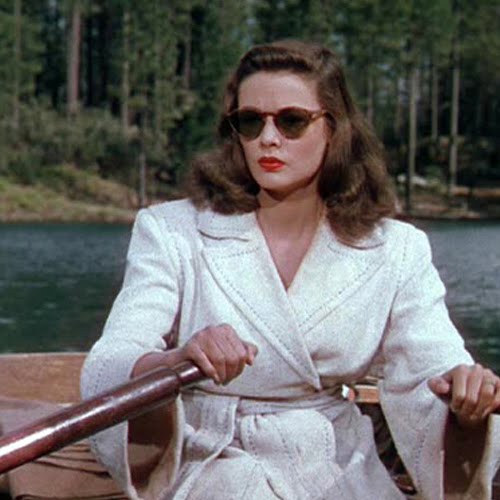
Gene Tierney fit perfectly into the femme fatale role so common in that era and it doesn’t hurt that she has a stunning face. Darryl F Zanuck thought that she was the most beautiful woman in movie history and it’s that very juxtaposition between her looks and her actions in this movie that make the role so good. And consider this, Rita Hayworth was originally intended to play this role but turned it down. We know that she can play against type as in ”The Lady from Shanghai” but I’m not sure Hayworth could have been as icy as Tierney. Take for example, that scene in the boat, which is very reminiscent of a scene in ”The Little Foxes with Bette Davis. Both sit as still as rocks, actively not involving themselves in the scene, mouths firmly set, very chilling. Tierney also out acts everyone else. While I agree that she had a far juicier role, I think that people might not have taken her acting seriously because of her looks though it’s important to note that she was nominated for an Academy Award for this role. She is monstrous as Ellen but we delight in watching her play the character.

As for her sister Ruth, played by Jeanne Crain, I found her boring, annoying and saccharine, ugh. She seemed to melt into the background and her main character trait was that she liked plants. Really? How about you make her more of a rival to Ellen? Make her more interesting to make me believe Richard’s thoughts would start to stray, let us know more about her background and how she feels about Ellen and her adoptive parents. And then there’s Danny. Has there ever been child more annoying on film and is it wrong that I didn’t miss him at all when he wasn’t there? I did feel bad for the actor Darryl Hickman who was in the water so long that he caught pneumonia when they were filming that swimming scene. I don’t know if we’re supposed to identify with Ellen at all but at points I sympathized with her.

This film is essentially all desire and obsession and how it can destroy a person as well as everyone around them. This is a typical message drawn from Film Noirs but the fact that this is a colour Film Noir makes it special. The locations burst with colour and the settings are gorgeous, especially the lake, contrasting with the fact that the film is full of death and murder. Despite having some horrifying scenes this movie was Fox’s highest grossing picture of the 1940s.

I loved seeing Vincent Price in this because it’s nice to see him in roles when he was younger, before he moved into his horror movie phase. I laughed when the dog started barking after a knock on the door as I made a joke that evil was approaching and there he was! He was great, especially in the court room scene although it started to get a bit hyperbolic towards the end.

As for the moral of the story, it’s communication people. If Ellen had just talked to Richard about how she felt about their relationship, how she felt about her sister and how she wanted time alone with Richard because Danny kept turning up like a bad penny, this could have all been avoided. Possibly. Maybe. Probably Not At All.

Rating: If you're a fan of classic movies and like Film Noir, you should own this and not let it get too dusty from lack of attention.

Sunday, August 05, 2012

"City Lights" (1931)

This post was originally intended for the Film Preservation Blogathon but I managed to screw that up. Instead it is here, blatantly overdue, for your reading pleasure.

"Tomorrow the birds will sing."

The Little Tramp, played by Chaplin, encounters a blind flower girl in town and falls head over heels. He wants to help her regain her sight and tells her he's going to pay to get her eyes fixed. Through no fault of his own, she assumes he's wealthy, a fact he doesn't correct. He then proceeds to do everything in his power to make money, from getting a job, to boxing, to asking his rich "friend" for a loan. This rich friend happens to be a suicidal drunk who Chaplin befriends and looks after. The two go on adventures but the fun only lasts as long as the friend is drunk. When sober, he forgets Chaplin and kicks him to the curb. Somehow the Tramp must continue the façade he's created and make enough money to help the girl he loves.

The music at the beginning has a very Gershwiny sound. Very "Rhapsody in Blue" but it says that Chaplin composed the music. Was he copying or emulating Gershwin? "Rhapsody in Blue" came out in 1924 so it's possible.

The introduction of the Tramp is very cute. A Peace and Prosperity Monument is being given to the city and when its unveiled he's found to be sleeping on the uppermost statue's lap. I loved how he climbed down, getting his pants caught on the sword blade and while everyone's yelling at him, the American national anthem starts. Everyone stops out of respect and removes their hats; meanwhile poor Chaplin is just trying to stay on his feet. His fall looks effortless and organic. I didn't however, like the remainder of his descent from the statue. Sitting on the statue's face, hand and putting his foot on the knee felt forced. To me there was no need to draw out the gag, it accomplished its purpose, introducing the audience to the Tramp. Back in 1931 it may have been easier to get away with such stunts but to me it weakened the film and diminished the humour at the beginning of the scene.

At first I didn't like that Chaplin decided any dialogue would sound like adults in Charlie Brown. In 1931 sound was available for films. In fact, this very film has sound, just not anyone's recorded voice. It does work within the context of a Chaplin film though, as the viewer gets the gist of what the characters are saying and it adds humour to the visuals, utilizing sound without making the film a "talkie". Chaplin would go on to do something similar in "Modern Times"

We then meet the love interest, a blind girl selling flowers. She hears Chaplin climb out of a taxi cab and assuming he's a rich man, asks him to buy a flower. A car meant a certain amount of wealth at this point in history as the US was in the early throes of the Depression and things were only getting worse. Chaplin was smart here though as the film shows that he and the audience learn she's blind at the same time. After buying a flower with what are probably his last few pennies he stays to watch her, obviously smitten. I feel her story is a play for sympathy because not only is she blind and poor, she's also an orphan. Why not just give her a dog that gets run over too?

In terms of the technical aspect, it took Chaplin 342 takes to get the flower girl introduction the way he wanted it as he couldn't figure out how to show that she thinks the Tramp is wealthy. And when you consider that Chaplin wasn't on good terms with the woman playing the flower girl, Virginia Cherrill, I just cringe at the thought of that many takes. In fact, their relationship was so volatile that he fired her after she came back to the set late one day and intended to shoot the rest of the film with another actor, Georgia Hale. Cherrill knew that was impossible considering how much footage they'd already shot and said she would come back to shoot the rest of the movie at double her salary. Talk about taking advantage of a situation! All told it took Chaplin more than three years to complete "City Lights".

Later that same day we see Chaplin trying to settle down for the night on a bench. He then notices a man in a suit trying to kill himself in the river. The man is obviously drunk and as he puts a rope tied to a rock around his neck, Chaplin tries to stop him and they both end up in the drink. They climb over one another to get out of the river and I flash back to a very similar scene with Keaton in a change room in "The Cameraman" where Buster's trying to get into a bathing suit. Here though, Chaplin and the suit fall into the river a second time and at this point the gag feels stale. It would have been interesting to see how Keaton would have played this.

This event leads to some great gags in the next scene though as the suit, who is grateful to Chaplin, invites him home to celebrate their new friendship. Chaplin has a slew of very smart alcohol gags that we see on full display: the suit accidentally pours a whole bottle of booze down Chaplin's pants; Chaplin dabs a little alcohol on the back of his neck like perfume; Chaplin resorts to dumping an unwanted shot into his shirt pocket. The two friends decide to go head out on the town. There are several more gags at the restaurant there are several more gags, involving a cigar and a streamer. My problem was I could guess what was going to happen next. I'm sure at the time the movie came out these gags were fresh, but I've seen too many films with similar situations, including a very memorable "I Love Lucy" episode featuring Bill Holden and spaghetti. Chaplin's genius here appears to be his downfall as so many people have imitated him that the joke has become tired.

While his friendship with Suit is on again off again, depending on his sobriety, Chaplin continues his quest to make money to restore his girl's sight. He takes a job as a garbage man which he isn't very good at and then misplaces the soap and washes his face with cheese. Ew. When his garbage job doesn't pan out, he takes up a very short-lived career in boxing during which he tries to fix his match. Cheeky bugger! We also get an awesome scene of Chaplin dancing and dodging behind the referee to escape his opponent during a match. This was the best part of the movie, not only because of the lack of cuts but because of the humour and the choreography involved.

There's another scene at Suit's house involving cops and robbers. Fortunately Chaplin escapes to the flower girl's house and tells her to take his money for her operation. He thinks he'll never see her again and lies to her about it. It might sound weird but at this point I think Keaton's better at emoting with his face than Chaplin. The Tramp is caught and sentenced to jail, during which the flower girl has an operation, can see again and opens up her own flower shop with the money left over from her operation. Their situations now much reverse, the Tramp reappears, looking shabbier than ever and at one point gets angry, which I think he does better than when he's acting happy. The flower girl sees him and laughs, appearing to pity him but then she offers a flower and there's that wonderful moment where she realizes who he is. The ending is very touching though Chaplin's body language seems very childlike, biting a finger and smiling at her

Everyone seems to love this film and it's been lauded by critics for decades as one of the top films ever made. Orson Welles said it was his favourite film, Fellini praised the film and Kubrick rated it among his top ten films. James Agee ever said the final scene was the "greatest single piece of acting ever committed to celluloid". Some even quote this as Chaplin's best movie but I can honestly say that I don't feel the same way. I liked the movie but I believe "Modern Times" holds a far better claim to the title 'Best Chaplin Movie'.

My biggest problem was with some of the gags. Some were too predictable while at other times it felt like Chaplin was overplaying his hand with repetition. This speaks to how influential Chaplin and the invention of slapstick was to the movie industry and how the idea of humour evolves over time. I didn't mind that it was a relatively quiet film but at times it strayed into the saccharine and sentimental which I don't like. There is wiggle room considering this movie is over 80 years old but I didn't enjoy it as much as I thought I would, considering the hype.

Rating: Using my brand new rating system I would says that "This is worth checking out of the library but don't worry about buying a copy to keep."

Friday, June 22, 2012

Anna Karenina Movie & Adaptations

I saw the trailer for a new adapatation of "Anna Karenina" the other day and am very intrigued. I tried to read the book once before and failed miserably. I'd like to watch the movie but as a rule, I read the book before I watch the adaptation. The same will go for "The Great Gatsby" which comes out later this year.

The Karenina translation recommended to me was the Pevear-Volokhonsky version. The translators are a husband and wife team who've translated Russian classics like Tolstoy, Chekov, Pasternak, Gogol and Dostoyevsky.

The movie looks interesting but I'm worried it's going to be more artsy than adaptationy. The look reminds me of "Russian Ark" a very good, one take film about the history of Russia. I'm not that excited by the casting so we'll see what happens. I'll probably also end up checking out the 1935 Garbo version and the 1948 Vivien Leigh version as well.

What do you think of adaptations in movies? I have mixed feelings about them.

There are going to be at least three giant adaptations this year alone with "Anna Karenina", "Les Miserables" and "The Great Gatsby". I do like that Hollywood appears to be moving away from sequels, remakes and reboots and looking to adaptations for movies. But again, adaptations of these films have been made before and may possibly retread familiar territory without bringing anything new to the screen, which questions the validity of making such movies.

I worry that adaptations are being made simply because it's been awhile since the last version was made and film makers assume the public is ready for the film to be remade. There have been 12 previous attempts to adapt "Anna Karenina" to the screen, the last one only seven years ago. So you may ask, why remake it again? I don't have the answer though it will be interesting to see what kind of adaptation it is. It appears to be faithful to the time period but without viewing the movie it's impossible to say if any other changes have been made.

I'm also not wild about the casting of Kiera Knightly. People are already starting to talk about this as her 'Oscar' role. Gods people! The movie hasn't even come out yet and already you're speculating. I've only ever really like her in her first role "Bend it like Beckham". I just don't think much of her acting. It's not that her acting is bad but I've never been wowed by a performance. This is perhaps an unfair judgement as I haven't seen all of her movies but then again, I don't know that I'm interested enough in Knightly as an actor to objectively look at her career and then pass judgement on her acting. There are other actors whose filmographies I'm far more excited by to spend time on Knightly. I can say that I saw "Pride and Prejudice" and wasn't impressed. I loved the set but I just didn't buy the two leads. Macfadyen seemed mumbly and wasn't snobbish enough for my tastes and Knightly wasn't nearly subtle or snarky enough. Again this is the problem with adaptations. Each director has their own vision which may not jive completely with the book. Who knows though, she may suprise me, as I'm sure Ledger did everybody in "The Dark Knight"


I do think that the ostentatious atmosphere of the 1920s may lend itself to the way Baz Luhrman films movies. "The Great Gatsby" may even benefit from his style though I demand substance as well. 'Pretty' movies are a dime a dozen and make for boring watching which the viewer soon forgets about afterwards. Again, this is another book I'm going to have to pick up before the film comes out but honestly, I can't wait. I love adaptations because they usually draw from great source material and hopefully it gives the book some much deserved attention. As well, it's the opportunity to see a story realised in the flesh. We get a visual representation of the words on the page. And haven't there been times when you wish there was a visual to accompany a situation or character?


"Les Miserables" is going to follow in the tradition of the Broadway musical and have singing. *Big sigh* Movies with singing aren't always strong on story as they spend so much time on the music. This film has Hugh Jackman as Jean Valjean who it's been proven, can sing. Russell Crowe also stars and while I'm not sure he can sing, I believe he'll more than be able to carry his acting role. My concern is Anne Hathaway. She plays Fantine and while I've heard her sing previously in "Enchanted" I wonder if her singing ability is up to the numbers in the movie. There are some very powerful pieces in the film that I would hate to not be fully realized. Hathaway sings in the trailer but it's not as I would expect for the role. I want a full bodied, powerful and passionate voice for all of Fantine's songs. I supposed I've been spoiled by Lea Salonga's Fantine on Broadway but just listen to the power behind her voice.

I've posted a video of one of her performances with the same song from the movie trailer so that you compare the two and make your own judgement. I know Hathaway's primarily an actor but she's sung at Carnegie Hall so she has experience singing. She definitely infuses the song from the trailer with emotion and Salonga's version is more of a performance but with a musical there has to be some suspension of belief. I thought it would be more interesting to see this film as a straight drama but as it's a musical, the film maker's know that they better have some damn good singers as their leads. A good musical can fizzle without them. For example, 2004's "Phantom of the Opera" was a musical, like the Andrew Lloyd Webber Broadway version. The leads were actors first and singers second and I felt the movie suffered for this. If you're making a musical, you can't take yourself seriously and should go full boar on the songs which is where I feel Phantom fell down. It was too busy trying to be pretty and dramatic without the gravitas of some amazing voices to anchor the performances.

In any case, I'm looking forward to all of these movies. Primarily because I love both books and movies and when you can combine the two, it can create something amazing.


So tell me, are you planning on seeing any of these films? How do you feel about adaptations?

Wednesday, May 30, 2012

Summer Movies!

.
This summer is when movie studios bring out the big guns (apart from Oscar season) and some of the best movies of the year come out.


These are the movies I'm looking forward to:

Snow White and the Huntsman

When I heard that there were two directors making live action versions of Snow White, I was not impressed. Then I saw the trailers and they may have slightly changed my mind. The two interpretations have been very different and the huntsman version makes Snow White into a bad ass! Doesn't that bark creature look cute?


The Amazing Spiderman

I thought that rebooting/remaking, whatever it is they're doing with this character was stupid. The Maguire version isn't even a decade old and it just felt like a money grab. But at the same time, Andrew Garfield's character looks and seems far more suited to the Peter Parker role than Tobey Maguire who looked like a 30 year old (which he is) trying to play a teenager when he was in the role. It will be interesting to see how this film differs from the 'original'.


The Dark Knight Rises

The Dark Knight was an amazing film and I have no idea if Nolan can actually top it. The trailer is amazing-looking though so we'll see. I have serious doubts about Catwoman so let's hope Hathaway proves me wrong just like Ledger did. I can't wait!


Frankenstein

Why is it that the Brits are always making awesome stuff all the time? Johnny Lee Miller and Benedict Cumberbatch star in this theatre production, streamed live with them switching roles between Dr. Frankenstein and the monster every other night!


Prometheus

I still haven't seen any of the movies in the Aliens series but this looks interesting! I love sci-fi movies if they're done well and Ridley Scott has a good track record. So I may have to cave and watch those creepy Alien movies. Ah darn it!


And for a bonus, the teaser for Skyfall, the new James Bond movie just came out and I couldn't resist adding it! Quantum of Solace was seriously disappointing so here's hoping the new film meet expectations.


The Great Gatsby

Okay just one more. This isn't out until Christmas but I love me some Art Deco and the whole feel of the 20s. I can't wait to see this. I only hope that it's good as adaptations have more baggage than regular films.


Are there any summer movies you're looking forward to?