At the beginning of the year I signed up for a yearlong reading project for "Les Miserables” by Victor Hugo. The fact that I’m only on week 2’s reading should tell how far behind I am. Being such a long book with weekly commitments, I lost interest and started in on "Titus Groan".
One of the reasons I’ve picked up the book again is because there’s another movie adaptation of the story coming out this year with Anne Hathaway, Russell Crowe and Hugh Jackman. I saw the trailer and didn’t think much of it, mostly because they’ve decided to take the musical route and while I know Mr. Jackman can sing, I don’t hold out much hope for the other leads.
In any case, I decided to log my thoughts on here, as well as references I’m unclear about and words I don’t know to keep a record of my progress and to encourage me to continue reading.
As well all references are in chronological order. My book is the Norman Denny translation.
 Epicurus
- 341 BCE - 270 BCE
- An Ancient Greek philosopher whose name means “ally, comrade”
- For him, the purpose of philosophy was to attain a happy life with ataraxia – ‘peace and freedom from fear’ and aponia – ‘the absence of pain’. He believed pleasure was the greatest good and to attain pleasure one should ‘live modestly and gain knowledge of the workings of the world and the limits of one’s desires’.
- His ideas actually seem very modern as he says death is the end of the body and soul and that the gods were physical beings that did not create the universe. He believed that they existed but that they either weren’t willing or able to prevent evil.
- This all feels very modern. It’s strange to think that 2000 years ago when religion played a far greater role in daily life that such ideas would be popular enough to create a philosophy
- There is a philosophy called Epicureanism based on his teachings. It was later repressed by Christianity.
- Some of his works were preserved by the eruption of Vesuvius. Known as the Herculaneum papyri, more than 1800 scrolls were carbonized at Herculaneum which was buried under volcanic ash. The work of unrolling, deciphering and publishing the writing in these scrolls continues today. If you want to learn more about the scrolls click here
- Did you know the poet Horace who followed the teaching of Epicurus, was the one who made the statement “Carpe Diem” (Seize the Day)
- He admitted women and slaves into his philosophy school
- He believed the world was made up of little bits of matter flying through empty space. The word “atom” comes from the Greek atmos which means ‘indivisible’
- This bit kind of scares me. Long before equipment was able to show us the atom, this guy had already come up with the idea?
- And then there’s the fact that his thoughts on morality also known as the Golden Rule (treat others as you would want to be treated) were picked up by some people who participated in the French Revolution as well as John Locke who wrote people had a right to “life, liberty and property”.
- Thomas Jefferson, one of the founding father of the United States, considered himself an Epicurean and wrote such things as “all men are created equal” and that they were entitled to “life, liberty, and the pursuit of happiness”.
- Karl Marx wrote his doctoral thesis on "The Difference Between the Democritean and Epicurean Philosophy of Nature”
- Even Nietzsche cites Epicurus several times in his works.
- The fact that his ideas and values have trickled down to modern day, despite the passage of time and the Dark Ages, is astounding and also very cool.
Pigault-Lebrun
- 1753 - 1835
- Born Charles-Antoine-Guillaume Pigault-Lebrun. Try saying that 10 times fast!
- Twice he carried off women and was imprisoned be lettre de cachet as a result
- Lettre de cachet are letters signed by the King of France which contained orders for actions and judgements that couldn’t be appealed. The king could intervene directly and make decisions without heeding current laws. Scary!
Urbane – Suave, courteous and refined in manner
Demagogue - A political leader who seeks support by appealing to popular desires and prejudices
- In Ancient Rome, a leader or orator who supported the cause of the common people. It's interesting how this meaning has changed over time
Needham’s eels
- John Needham 1713-1781
- An English biologist and Roman Catholic priest
- A religious scientist? Awesome!
- Once upon a time there was a belief that said life could spring from inanimate matter. Needham apparently did some experiments and while I couldn’t find anything definite about what was up with his ‘eels’, he did get into a big tiff with Voltaire who mocked him for believing that eels could spawn out of gravy.
Tertullian
- aka Quintus Septimius Florends Tertullianus 160-225
- A prolific Christian writer from Carthage, also known as “the father of Latin Christianity” and “the founder of Western theology”.
- Well those are some heavy titles!
“One can eat or be eaten and I would sooner eat.”
- This brings Bill the Bard to mind when he said “they are all but stomachs, and we all but food” – Othello
- Both equally gross but true if you think about it. Life is all about who’s eating and who’s being eaten
Sardanapalus
- According to Ctesias of Cnidus he was the last King of Assyria
- Apparently he spent his entire life indulging himself and died “in an orgy of destruction” which sounds painful
- This ‘indulging’ included dressing in women’s clothes, wearing make-up
- He stated physical gratification was the only purpose of life, which sounds suspiciously Epicurean in tone.
- To keep himself from falling into enemy hands he had a pyre built of gold, silver and other accoutrements, had his eunuchs and concubines trapped inside the pyre on which he burned himself and them to death. Gross!
- His decadence became a theme in literature and art
St. Vincent de Paul
- 1581-1660
- A Catholic priest dedicated to serving the poor, canonized in 1737
- That would explain that thrift shop that carries his name!
- In 1605 he was captured by Turkish pirates and sold into slavery. He then converted his owner to Christianity and escaped in 1607. This sounds like a 1960s Disney movie plot!
- He is known as the “Great Apostle of Charity”.
- His body was exhumed in 1712 after which his bones were encased in a reliquary in Paris as was his heart. Ew.
Cato
- 95BCE-46BCE
- There are two more well known Cato’s, Cato the Elder and Cato the Younger. Because Cato the Younger lived during the end of the Republic, I wanted to talk about him more.
- His parents died when he was young (just like Batman) and he was raised by his maternal uncle who was then murdered when he was 4 (geez)
- At age 14, he asked his tutor why no one had yet killed the Roman dictator Lucius Cornelius Sulla. His tutor said “They fear him, my child, more than they hate him”. Cato replied,
“Give me a sword, that I might free my country from slavery.”
- He gave up his wife Marcia because a man named Q Hortensius Hortalus desired a connection to the family and suggested he marry Cato’s wife as she had already provided him with heirs.
- I’d like to nominate Cato for Worst Husband Ever for treating his wife like a piece of furniture.
- After Caesar had taken over, Cato took his own life, not wanting to live in a world led by Caesar.
- He was one of the staunchest supporters of the Republic
- His nephew was Brutus. Yes, that Brutus!
- Virgil made Cato a hero in “The Aeneid”. Dante made him the guardian of the mount of purgatory in “The Divine Comedy”. A play about him was performed at Valley Forge thanks to George Washington during the American Revolutionary War and a sculpture of him stands in the Musee du Louvre in Paris
Sinecure – A position requiring little or no work but giving the holder status or financial benefit
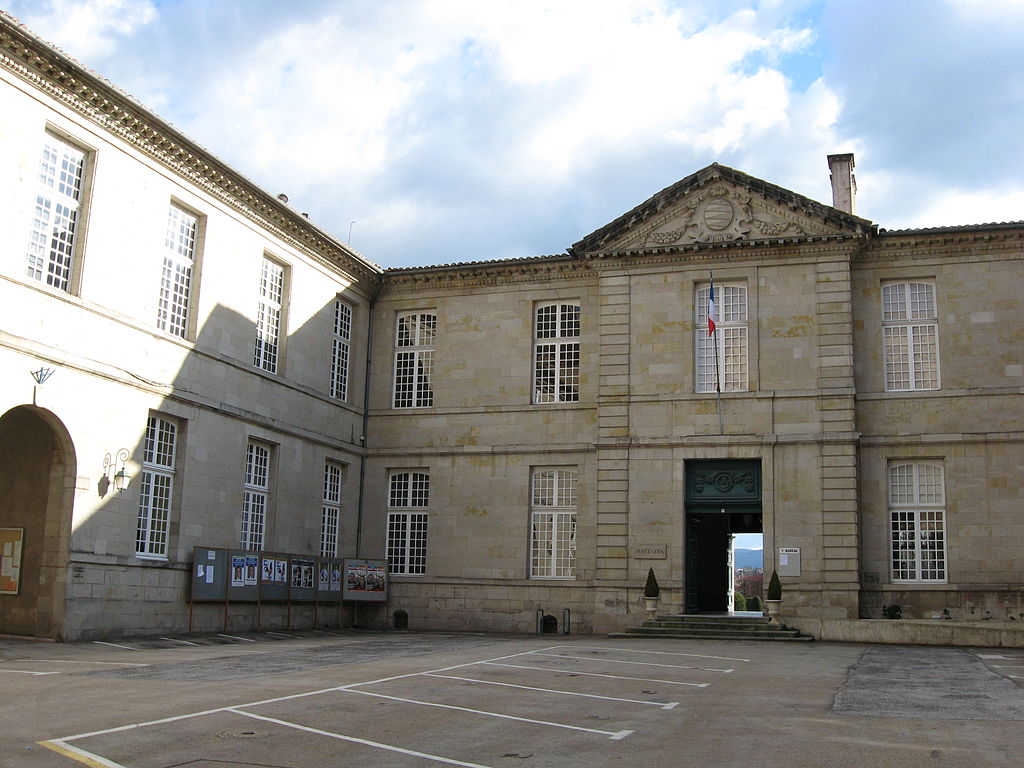
Digne
- Digne-les-Bains is a commune of France in the Provence-Alpes-Cote d’Azur Region
Telemachus
- Off the top of my head I can tell you who he is, Odysseus’ son who doesn’t really remember his father, having been gone ten long years fighting the Trojan War. When I first read this ten years seemed a long time to be at war but with the War in Afghanistan, that number doesn’t seem so silly anymore.
- After Odysseus returned he roped his son into helping drive off all the suitors for Penelope’s hand in marriage. How Telemachus recognized his father is beyond the foggiest
- I did not know that the first four books of “The Odyssey” which focus on Telemachus’ journey are also known as the ‘Telemachy’.
- His name means “far from battle”
- He gets pretty violent at the end of “The Odyssey”
Minerva
- The Roman name for the Greek Goddess Athena
- Venerated in Athens, a city named after her, she also had a giant statue located in the Parthenon
- She was the Goddess of War and Wisdom which seems contrary but oh well
- Her symbol is an owl
- She was born out of her father’s head and therefore had no mother. One day her father Zeus had a headache, Hephaestus struck him on the head and out popped Athena. Totally weird I know.
Consul
- The highest elected office in the Roman Republic
- This title was also used under the First French Republic when Napoleon came around taking over everything.
“The devil may visit us, but God lives here.”.
Azrael
- A name for the Archangel of Death.
- In the movie “Dogma”, Jason Lee plays Azrael, fallen muse and demon
- He also happens to be a superhero in the DC Comics universe.
- This is the name of a group of characters who are assassins
Exordium – The introductory portion of an oration, discourse or treatise
“The clouds had been gathering for 1500 years and at last the storm broke. What you are condemning is a thunderclap.”
Cartouche
- aka Louis Donimique Garthausen
- 1693-1721
- A French highwayman who robbed from the rich and gave to the poor until he was apprehended and broken on the wheel
- Both of his brothers were sentenced to the galleys. The younger was ordered to be hanged by his armpits for two hours first but the pressure of the rope on his ribs killed him.
Place de Greve
- Now known as Place de l’Hotel de Ville (City Hall Plaza), it was known as the Place de Greve before 1802
- ‘Greve’ means a flat area covered with gravel or sand by the banks of a body of water
- Originally it was a meeting place for where unemployed people gathered to seek work
- The gruesome aspect is it was the site of most of the public executions in early Paris as the gallows and pillory stood there.
- Some notable people killed in the area were assassins Francois Revaillac and Robert-Francois Damiens as well as Guy Eder de La Fontenelle as well as where the heretic Marguerite Porete died.
- Ravaillac is a serious case as he committed regicide (meaning he killed a king) and murdered King Henry IV in 1610
- Damiens was a regicide as well and attempted to assassinate King Henry XV in 1757. The way this guy died was in the worst way imaginable, involving red-hot pincers, burning sulphur, molten wax, molten lead, boiling oil, dismemberment and burning at the stake.
- Marguerite was a French mystic burned at the stake
- Interestingly, Casanova, yes that Casanova, witnessed his execution
- Thomas Paine mentions the execution in “Right of Man” as does Mark Twain in “A Connecticut Yankee in King Arthur’s Court” and Charles Dickens in “The Tale of Two Cities”
Barrabas
- His name means “Son of the father”
- He is the insurrectionist whom Pontius Pilate freed at the Passover feast in Jerusalem
Jean-Paul Marat
•1743-1793
•A radical journalist and political during the French Revolution
•He was murdered in his bathtub by Charlotte Corday, who was later guillotined, claiming “I killed one man to save 100,000”
•Jacques-Louis David created the painting “The Death of Marat”
•His eulogy was given by the Marquis de Sade (that’s a little weird)
Interesting to note that de Sade was removed from office and imprisoned for “moderatism” because he started to object to The Reign of Terror. Oh irony!
•Strangely enough Marat became a common name in Russia
•The bathtub he was murdered in was bought for 5000 francs and now lives in the Musee Grevin
Jean-Baptiste Carrier
- 1756-1795
- A French Revolutionary
- Known for his cruelty to enemies, especially clergy
- Disposed of prisoners in increasingly torturous ways. Adolphe Thiers wrote “This frantic wretch imagined that he had no other mission than to slaughter”
- A famous incident known as the Drowning at Nantes. This was a series of mass executions by drowning where as many as 4000 people lost their lives including women and children, Catholic priests and nuns. One man survived the first set of drowning named Father Landeau
- In 1794 he was arrested and denounced allegations of his inhumanity, claiming he knew nothing about the drowning. A man jumped up “vocally charging Carrier with drownings, wholesale executions, demolitions, thefts, pillaging, laying waste to Nantes, famine and disorder, and with the butchering of women and children.” The vote for his execution was unanimous
Antoine Quentin Fouquier-Tinville
•1746-1795
•A lawyer whose gained the reputation of one of the most sinister figures of the French Revolution
Acted as prosecutor in the trials of Charlotte Corday (assassin of Marat) and Marie Antoinette.
•His career came to an end with the fall of Robespierre, after which he helped in the arrest of Robespierre and was then arrested himself. He protested that he was only obeying orders but was sentenced and guillotined.
Stanislaw-Marie Maillard
•1763-1794
•He participated in the attack on the Bastille and afterwards became the Captain of the Volunteers of the Bastille
•He was also known as “Chief of the Murderers”
•This next part is hearsay but also gross. He released the marquis Charles Francois de Virot de Sombreuil who was saved by his daughter Marie Maurille, who legend says, had to drink a glass of blood in order that her father’s life be saved
•He died of tuberculosis unlike many of his contemporaries who went the way of the guillotine
Mathieu Jouve Jourdain
•? - 1794
•Aka Jourdan Coupe-Tete was implicated in the massacres of La Glaciere at the Palais des Papes at Avignon in 1791. A municipal administrator was lynched and 60 people were executed in a tower afterwards
•Jourdain was condemned to the guillotine
Apostate – a person who renounces a religious or political belief or principle
Did You Know: French troops arrested Pope Pius VII and take him to Liguria. The Pope! Arrested!
•What happened was the Papal States were annexed (taken over) and the Pope was taken prisoner and exiled to Savona
Cardinal Joseph Fesch
•1763-1839
•Closely associated with Napoleon Bonaparte
•One of the most famous art collectors of the period: Michelangelo, Da Vinci, Botticelli, Raphael
Ultramontane – Advocating supreme papal authority in matters of faith and discipline
Battle of Austerlitz
•December 2 1805
•Fought in Austerlitz, Moravia, Austrian Empire between France, Russian and the Holy Roman Empire
•Also known as the Battle of the Three Emperors
•France won resulting in the dissolution of the Holy Roman Empire!
Seditious – Inciting or causing people to rebel against the authority of a state or monarch
Potentates – A monarch or ruler
Prebends – The portion of the revenues of a cathedral or collegiate church formerly granted to a canon or a member of the chapter as his stipend
Rota – The supreme ecclesiastical tribunal for cases appealed to the Holy See from diocesan courts for the Roman Catholic Church
Conclave – A private meeting
- The assembly of cardinals for the election of a pope in the Roman Catholic Church
Pallium – A woolen vestment conferred by the pope on an archbishop consisting of a narrow, circular band placed around the shoulders with short lappets hanging from front and back
Tonsure – A part of a monk’s or priest’s head left bare on top by shaving off the hair
Penurides – Extremely poor; poverty stricken
Juvenal
•aka Decimus Iunius Iuvenalis
•1st century AD – 2nd century AD
•His work influenced Samuel Johnson
Tacitus
•56AD – 117AD
•A senator and considered to be one of the greatest Roman historians, living in what has been called the Silver Age of Latin literature
oHis two major works were “Annals” and “Histories” in which he covers the reigns of Nero, Tiberius and Claudius as well as the death of Augustus and Domitian
oA well known passage from the “Annals” mentions the death of Christ
oAt the National Law Enforcement Officers Memorial is a quote by him: “In valor there is hope”.
-I rather like that quote
Adulated – To praise someone obsessively or obsequiously
Peirre Corneille
- 1606-1684
- A French tragedian and one of the three great 17th century French dramatists along with Moliere and Racine
- Also known as the founder of French tragedy
- His surname is also the French word for “crow”
Sambre-et-Meuse
- The name of a department of the First French Empire in present Belgium
- Named after the rivers Sambre and Meuse (ha ha, who would have though)
- After Napoleon’s defeat in 1814, the department became part of the United Kingdom of the Netherlands
Quia Multum Amavit - Because she loved
Palimpsest – A manuscript page from a scroll or book from which the writing has been scraped off to make room for later writing
Pope Gregory XVI
- 1765-1846
- He opposed democratic and modernizing reforms in the Papal States and Europe
- He opposed technological innovations such as gas lighting and railways believing they would ultimately undermine the power of the Pope over central Italy. He actually banned railways in the Papal States, calling them chemins d’enfer (“ways of hell”)
- He also condemned the slave trade, calling it inhuman and forbade any lay person or Ecclesiastic from defending the trade as permissible
Abstruse – Difficult to understand; obscure
Apotheosis – The highest point in the development of something; culmination or climax
“A sacred terror haunts the threshold of Enigma; the dark portals are flung wide, but there is a voice which warns the passer-by not to enter.”
Emanuel Swedenborg
- 1688-1772
- A Swedish scientist, philosopher, inventor
- He called himself a “Servant of the Lord Jesus Christ”
- He claimed the Lord had opened his eyes and that he could freely visit heaven and hell and talk with angels and demons
- He claimed that faith and charity were necessary for salvation
- He influenced a lot of people: William Blake, Jorge Luis Borges, Sir Arthur Conan Doyle, Ralph Waldo Emerson, Carl Jung, Immanuel Kant, Honore de Balzac, Helen Keller, August Strindberg, WB Yeats
Blaise Pascal
- 1623-1662
- A French philosopher, writer, inventor, physicist and mathematician
- Invented Pascal’s triangle
- Invented the hydraulic press, the syringe
- His name was given to the SI unite of pressure, a programming language, Pascal’s law and Pascal’s wager
Elijah
- His name means “Yahweh is my God”
- A prophet in Israel during the reign of Ahab
- He raised the dead, brought fire down from the sky (lightning?) and was taken up in a whirlwind
- His return was prophesied “before the coming of the great and terrible day of the Lord"
St Teresa
•1515-1582
•Also known as Teresa of Avila
•She was a writer and Spanish mystic
•Her paternal grandfather was condemned by the Spanish Inquisition
oEveryone totally expects them. They said they were coming over. They even rang the doorbell.
•She suffered from an illness which caused
oBernini was inspired by this to created the “Ecstasy of Saint Teresa” at Santa Maria della Vittoria in Rome
oThis experience led to a motto which is often associated with her: “Lord, either let me suffer or let me die”
St Jerome
- 347-420
- Born as Eusebius Sophronius Hieronymus
- A priest, confessor, theologian and historican
- He is best known for his translation of the Bible into Latin, known as the Vulgate bible
- Why it’s not known as the Jerome Bible, I don’t know. Vulgate, sounds either lupine or vulgar
Nihil - Nothing
Ens - An existing or real thing
Titus Lucretius Carus
- 99BC – 55BC
- Very little is known about his life
- His poetry introduced Roman readers to Epicurean philosophy
- There’s that guy again! Man Epicureanism is everywhere!
- He is mentioned by various artists: Ovid, Michel de Montaigne, Antoine de Saint-Exupery, Dante, Goethe
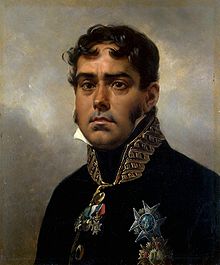
General Antoine Druout
 |
| Antoine Drouot |
- 1774-1847
- One of the select few who were present at the Battle of Trafalgar (1805) and the Battle of Waterloo (1815)
- His name is inscribed on the western pillar under the Arc de Triomphe
- He took part in the battles of the French Revolution
- He was with Naopleon during his exile on Elba
- After the restoration of Louis XVIII, Druout stood trial for treason in which he defended himself skillfully. He was acquitted and granted a state pension
Golfe Juan
- March 1 1815 Napoleon Bonaparte landed here with 600 men after his escape from Elba
Ferrule - A metal ring or cap placed around a pole or shaft for reinforcement to prevent splitting
Volubly - A ready and continuous flow of words
Patois - A regional dialect; nonstandard speech
Marquise - The wife or window of a marquis; a lady holding rank equal to that of a marquis
Epistle to the Ephesians
- aka Letter to the Ephesians
- 10th book in the New Testament
- The main is "the Church which is the Body of Christ" also the keeping of Christ's body pure and holy
- Traditionally it has been attributed to the Apostle of Paul who wrote it while in prison in Rome around AD62. The authorship is in question though
Epistle to the Corinthians
- aka First Corinthians
- Authorship is attributed to Paul
- It was written in Ephesus. According to the "Acts of the Apostles", Paul founded the church in Corinth and spent three years in Ephesus during which time he wrote the epistle, usually dated around AD53-57.
- Technically there were three Corinthian Epistles but only two are considered canon. 3 Corinthians is considered Apocrypha.
Peruke - A man's wig fashionable in the 17th and 18th centuries; a periwig
- The interesting thing here is that the wig is being worn by a woman, Mlle Baptistine and it's out of fashion. But as noted earlier in the sentence, she is wearing a gown cut in the 1806 pattern. So it's established that she is behind the times in terms of clothing
Curé - A parish priest especially in a French-speaking country
Ignominy - Great personal dishonour or humiliation; shameful or disgraceful action, conduct or character
Battle of Montenotte
 |
| Antoine Rampon galvanizes the French against Argenteau |
- April 12 1796
- Fought during the French Revolutionary Wars between Bonaparte and Austrian corps under Count Eugene-Guillame Argenteau
- The French won and it was the first victory of the Montenotte Campaign, with French loses of around 800 troops
The 500
- aka the Council of 500
- The lower house of the Legislature of France during the Directory Period (1795 - 1799) aka the second half of the French Revolution
- Each member of the 500 had to be at least 21, meet residency qualifications and pay taxes. A third would be replaced annually
- Napoleon led a group of grenadiers who drove the Council from their chambers and installed himself as leader of France as First Consul in the coup on the 18th of Brumaire (November 7 1799)
2nd Florian Year IV
- aka April 20/21
- A date from the new calendar, the French Republican Calendar/the French Revolutionary Calendar
- It was used for 12 years from 1793-1805
- It was designed to remove all religious and royalist influences from the calendar and was part of a larger attempt at decimalisation in France
- The year began the day the autumnal equinox occurred in Paris and had 12 months of 30 days each. The months were given new names based on nature having to do with the prevailing weather around Paris
- Each day was divided into 10 hours, each hour into 100 minutes and each minutes into 100 seconds
- Autumn
- Vendemiare (grape harvest)
- Brumaire (mist)
- Frimaire (frost)
- Winter
- Nivose (snow)
- Pluviose (rainy)
- Ventose(windy)
- Spring
- Germinal (germination)
- Floreal (flower)
- Praireal (meadow)
- Summer
- Messidor (harvest)
- Thermidor (summer heat)
- Fruchidor (fruit)
Turnkey - A person who has charge of the key of a prison; a jailer
Question: If the red smock the prisoner's wear a way to indicate what they are if they try to escape?
Claude Gueux
- A short story written in 1834 by Victor Hugo
- It's considered an early example of "true crime" fiction
- It contained Hugo's early thoughts on societal injustice, a theme he would revisit 30 years later in "Les Mis"